
Hola, it’s me again!
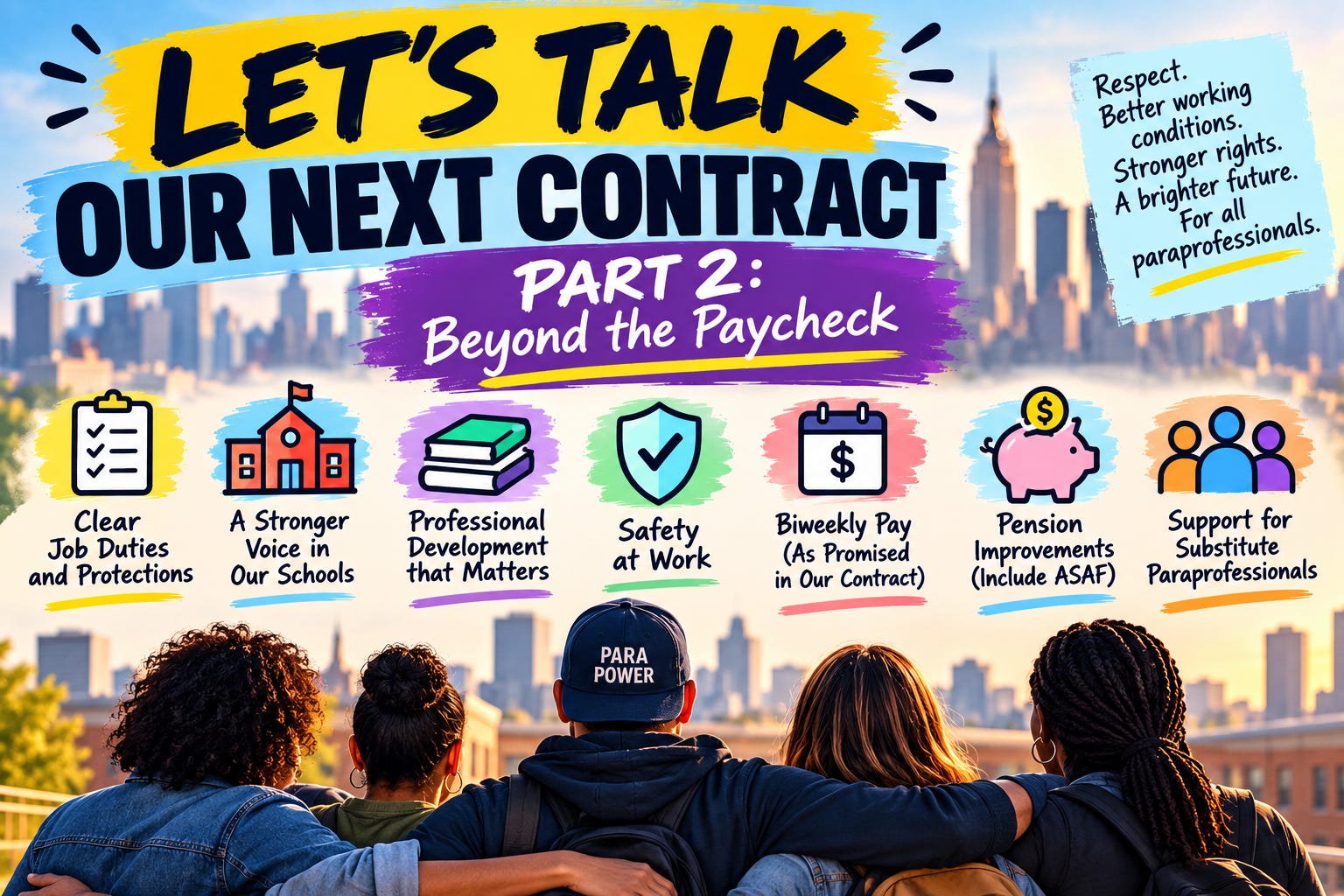
In Part 1 of Let’s Talk About Our Next Contract, we talked about the money. A $10,000 base salary increase. Meaningful raises. A better longevity schedule. Differentials for specialized and high-need assignments. Pensionable compensation. Basically, the money part. However, our contract is about more than a paycheck.
A good contract should also answer a very simple question: ‘What does it mean to be respected at work?’ That's what I want to talk about today. Respect has to be written down. Especially now, when administrators everywhere are saying to us, let me see that in writing.
We hear the word respect a lot. Respect paraprofessionals. Respect the work we do. Respect our voices. Heck yeah, I agree. What does respect look like when you put it into a contract? We don't want respect to just be something we hear during election season.
We want protections. We want rights. We want a real voice. We want clear rules, and we want those things written down so that when a problem happens, a paraprofessional doesn't have to wonder: ‘Do I actually have any rights here?’
Of course, our current contract already contains some important protections. The agreement provides a grievance process for complaints, it gives employees the right to have union representation when discussing those complaints with supervisors.
That's good. It’s great. After talking to paraprofessionals, I keep hearing the same thing:
Having a right on paper isn't enough if exercising that right is difficult, unclear, or inconsistent. So, let's talk about what else we need to be negotiating.
1. Clear Job Duties and Protection from Being Used for Everything
Let's be honest. Paraprofessionals do A LOT. We support students academically. We help with behavior. We provide personal care. We assist students with disabilities. We translate. We communicate with families. We help teachers. We help administrators. We do things that sometimes have nothing to do with what we were hired to do, and sometimes the answer is simply: ‘You're a para. Just do it.’
No. That's not good enough. Our contract already recognizes that paraprofessionals should be informed about the program guidelines that affect their duties and working conditions. We need to go further. The next contract should clearly define:
• What paraprofessionals are expected to do.
• What duties are outside our normal responsibilities.
• What additional training is required for specialized assignments.
• What happens when we're repeatedly assigned duties outside our title.
• How disputes over assignments are handled.
• And who is responsible for enforcing those rules.
‘Other duties as assigned’ should not mean ‘anything anyone wants you to do.’
2. A Real Voice in Our Schools
We work in these schools every day. We know our students. We know our classrooms. We know what works, and what doesn't. Yet too often, decisions are made about us without us. Paraprofessionals need a stronger and more consistent voice. We need the next contract to strengthen paraprofessional representation on school committees dealing with things like:
• Working conditions
• Scheduling
• Safety
• Student support
• Professional development
• School climate
• Staffing
• School resources
Let's make sure that voice isn't just: ‘We invited a para to the meeting.’ No. Being in the room isn't the same as having a voice. Make us mandatory core members of consultation and other school-based union committees.
3. Better Professional Development
Here's something else. We are expected to support students with increasingly complex needs, but sometimes our professional development doesn't match the work we're actually doing. We want meaningful training in areas like:
• Behavior support.
• Autism.
• Crisis prevention and de-escalation.
• Assistive technology.
• Bilingual and multilingual student support.
• Trauma-informed practices.
• Supporting students with significant disabilities.
Not just a PowerPoint that someone clicks through because it's a Monday or Tuesday afternoon. Real training. Training that helps us do our jobs better, and training that recognizes that paraprofessionals are professionals too.
4. Safety Should Never Be Negotiable
Let's talk about something serious. Safety. Some paraprofessionals are physically assaulted at work. We work with students with significant behavioral needs, provide intensive personal care, work with medically fragile students, and are placed in situations where they don't feel safe. We want stronger contractual protections around:
• Assaults and injuries.
• Staffing in high-risk assignments.
• Crisis situations.
• Training before being placed in specialized assignments.
• Access to appropriate protective equipment.
• Reporting unsafe conditions without fear of retaliation.
• Follow-up after serious incidents.
• Mental health support after traumatic workplace incidents.
When a paraprofessional says: ‘This isn't safe.’ The response shouldn't be: ‘You'll be fine.’ It should be: ‘Let's make it safe.’
5. Stop Making Paraprofessionals Afraid to Speak Up
This one is personal. I've talked to paraprofessionals who are afraid to ask questions. Afraid to challenge something. Afraid to report a problem. Afraid that speaking up will somehow make their work life harder. That should not be normal. We need a culture and contractual protections that make it clear that speaking up isn't misconduct. Asking a question isn't insubordination. Disagreeing respectfully isn't disloyalty, and raising a workplace concern shouldn't make someone a target. If we want paraprofessionals to have a voice, we must make it safe for them to use it. Oh, and that goes for within our union too!
6. Substitute Paraprofessionals Need a Voice Too
After my last article, we can't leave this one out. Substitute paraprofessionals are part of this conversation. They need a pathway to permanent employment. They need better protections. They need meaningful long-term assignment rules. They need access to professional development, and they need to be included when we talk about the future of the paraprofessional chapter. We can't talk about a paraprofessional shortage while ignoring thousands of people already doing the work. They deserve a seat at the table too.
7. Pay Practices
Then there are those things in our contract that make you stop and say, ‘Wait… that’s in there?’ Buried near the end of our contract is a provision that says the parties agreed that biweekly pay gives employees a date certain for receiving their paycheck. It even says the Board would convert paraprofessional payroll from semi-monthly to biweekly ‘as soon as practicable.’ Wait, what? How long has that been in our contract? And why haven’t we already done it? For paraprofessionals living paycheck to paycheck, getting paid every two weeks could make managing bills and everyday expenses a little easier. You know exactly when your next paycheck is coming. There’s less guessing and more predictability.
If our contract already recognizes that biweekly pay benefits employees, then it’s time to stop talking about it and make it happen. We need that. And we need it now.
8. Paras and Our Pensions
I said Part 2 was about the non-financial issues, but there’s one financial issue I can’t leave out: retirement security. Paraprofessionals won the right to join the Teachers’ Retirement System (TRS) in 1983. But for decades, joining was a choice, and for some paras, the cost made that choice difficult. Then, in 2021, that changed. Paraprofessionals became automatic members of TRS. That was a big step forward. Now that we are automatically members of TRS, why are we still left out of certain retirement benefits?
Take ASAF, the Annuity Savings Accumulation Fund. David Kazansky talked about it in my last video. It provides a $400 annual supplemental retirement contribution for TRS members. Paraprofessionals aren't included. Why not? We are asking that paraprofessionals be given an ASAF-equivalent benefit so we can build additional retirement security too. Four hundred dollars a year may not sound like much, but over a career, it adds up, and when you're talking about retirement, every bit matters. This is a perfect example of something we believe should be on the bargaining table. This is real respect.
So, What Does Respect Actually Look Like?
It looks like this:
• A paraprofessional who can speak up without being afraid.
• A paraprofessional who knows exactly what their job responsibilities are.
• A paraprofessional who gets meaningful training.
• A paraprofessional who is safe at work.
• A paraprofessional whose concerns are taken seriously.
• A paraprofessional who has a voice in their school.
• A paraprofessional who can challenge a violation and actually get it resolved.
• A paraprofessional who can build a career without having to leave the title.
• A substitute paraprofessional who has a real pathway to becoming permanent.
That's what respect looks like to us. Of course, none of this means we throw away everything that's already in our contract. Quite the opposite. Our contract already contains some good stuff. The question is, how do we build on them? How do we strengthen them? How do we close the loopholes? How do we make them easier to enforce? How do we make sure they actually work for the paraprofessional standing in a classroom at 9:15 on a Tuesday morning? That's where a contract matters. Not in a binder. Not on a website. In real life.
This is why we need to listen. I don't pretend to have every answer. I said that in Part 1, and I'll say it again. I'm learning. I'm reading the contract. I'm talking to paraprofessionals, and, most importantly, I'm listening.
That's what we think our union should be doing too. Before we decide what paraprofessionals need, let's ask paraprofessionals. Before we write proposals, let's hear the stories. Before we go into negotiations, let's know what is happening in classrooms across this city.
The paraprofessional working in a District 75 classroom may have very different concerns from the para working in a general education classroom. A 1:1 may have different concerns from a classroom para. A bilingual para may have different concerns from a substitute. A 25-year veteran may have different concerns from someone in their first year. We need to hear all of them, and that's the point we’re trying to make.
Part 1 Was About the Money. Part 2 is about everything else, and it’s worth repeating: this is just a start. There’s so much more we should be negotiating. We won’t get it all, but we shouldn’t limit our chapter to anything less.
We probably won't get everything we ask for. That's collective bargaining. You negotiate. You compromise. You fight for what matters, but we can't negotiate what we never put on the table.
So, let's keep talking. What did I miss? What is happening in your school that needs to be in the next contract? What's the one non-financial issue you would fight to change? Tell me. Send me your story. Let's keep listening and talking to each other, because if this contract is supposed to represent us, then it should actually sound like us.
Until next time, Adiós, my friends.