The $10,000 check passed, but did we really win?
As the politics intensify, paraprofessionals must keep their focus on the goal that matters most: a living wage through collective bargaining.

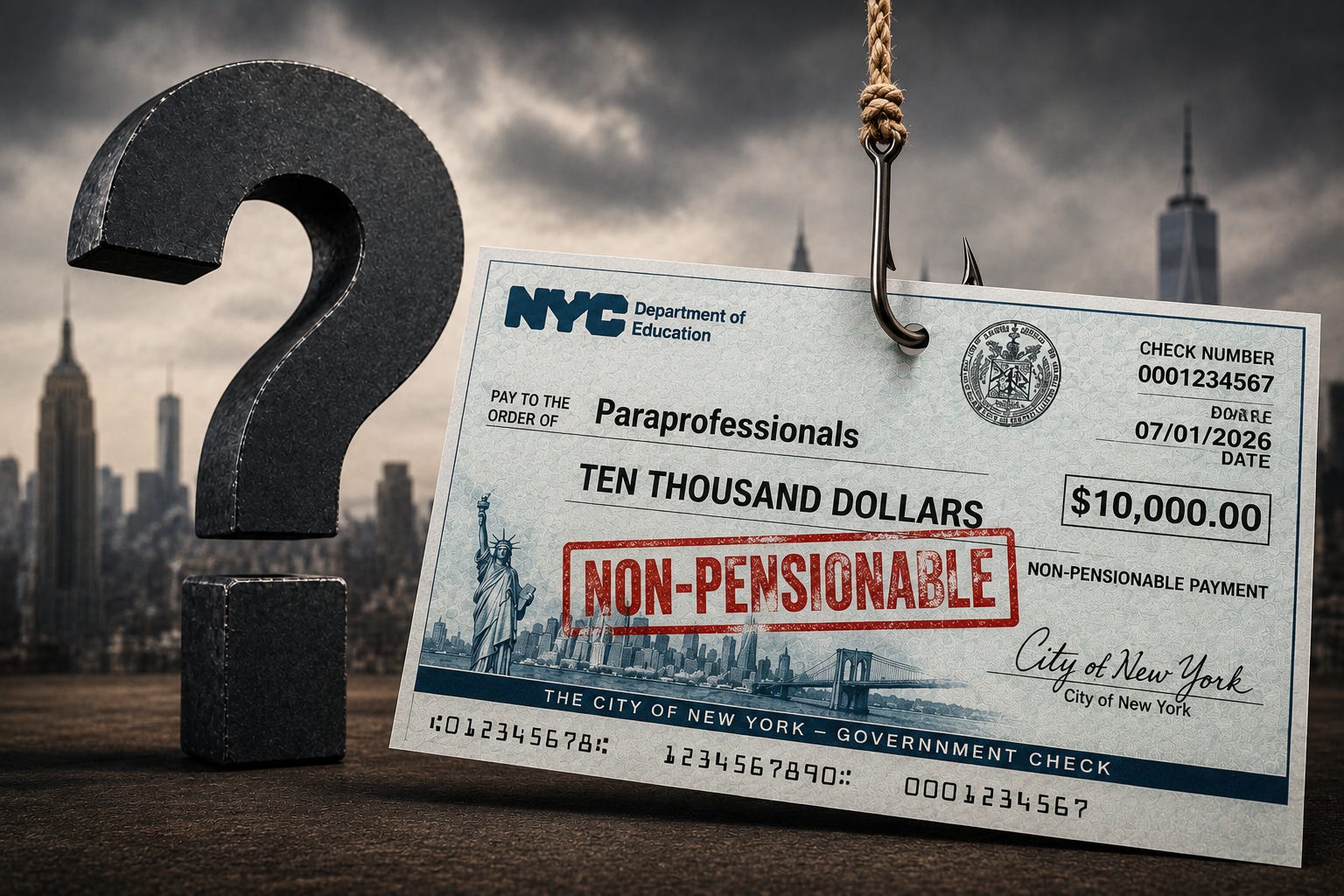
The $10,000 Check Passed. So...Now What?
Great news but, something doesn't feel right. I know many paraprofessionals are celebrating because the City Council passed the so-called "RESPECT Check" bill, and honestly, I understand why.
If you're living paycheck to paycheck, If you're working two or three jobs, if you're wondering how you're going to pay your rent or buy groceries, an extra check sounds like relief. For many of us, it will be. I'm not going to sit here and tell another paraprofessional they shouldn't want money. We deserve more money. We always have.
Here's what has been bothering me. The conversation is splintering. Instead of talking about how to finally win a living wage through our contract, we're now watching what feels like a political sh-t storm unfold around a bill that was supposed to be about us.
Every day there seems to be another headline. One day it's questions about whether the bill violates the Taylor Law, the next day it's talk of lawsuits. Then elected officials begin discussing whether other city workers should receive similar payments. Now there is political speculation about alliances between union leadership and City Council Speaker Julie Menin, with some suggesting it could have implications for future mayoral politics (our COPE contributions hard at work). I don’t want paraprofessionals to stop being the story, but it feels like we are becoming a political buzzword.
Wait...What's the Taylor Law? If you've been hearing people throw around the words ‘Taylor Law’ and wonder what everyone is talking about, here's the simple version. The Taylor Law is a New York State law that governs labor relations for public employees. Among other things, it generally requires wages and benefits for public employees to be negotiated through collective bargaining between unions and employers rather than set through legislation. It also prohibits strikes by most public employees.
That's why some people and some city officials have questioned whether this legislation could face court challenges, while others argue the bill does not violate the law. The legislation itself states that the payments are intended as temporary ‘workforce stabilization payments’ until compensation is addressed through collective bargaining and says it is not intended to diminish bargaining rights.
The law also makes clear that the payments are non-pensionable, up to $10,000, paid in installments, to paraprofessionals staffed only in the 2026-27 school year and that the law expires if a collective bargaining agreement provides an equal or greater increase in annual compensation. That's important because even the legislation recognizes something being said by many. This was never supposed to replace collective bargaining!
So why have we spent almost three years trying to get this passed? Instead, we should be talking about the real problem! Let's be honest with each other. After taxes, after deductions, after union dues, many paraprofessionals may take home significantly less than $10,000. Will that help? Absolutely! It might catch someone up on rent, pay off a credit card, fix a car, buy groceries, just take some pressure off. No one should dismiss that, but after that money is gone; We're still paraprofessionals making paraprofessional salaries.
We're still facing the same cost of living. We're still trying to survive in one of the most expensive cities in America. The Mayor's own True Cost of Living report says a single adult needs about $70,000 a year just to reach basic economic security. Get us there. That should be the goal. Not temporary relief. Permanent change.
Here's what frustrates many of us. We've spent nearly three years fighting over a non-pensionable bonus. Imagine if those same three years had been spent organizing tens of thousands of paraprofessionals. Listening. Building proposals together. Developing a comprehensive bargaining strategy. Preparing for negotiations. Imagine where we'd be today. Instead, contract negotiations are approaching, and we still have questions.
Who is actually sitting on the negotiating committee? How were they chosen? Is there representation from:
Elementary schools?
Middle schools?
High schools?
District 75?
Pre-K?
One-to-one paraprofessionals?
Classroom paraprofessionals?
Health paraprofessionals?
Bilingual paraprofessionals?
Every borough?
Every district?
Or were members simply selected by the para chapter leader, the 1st vice chair, the 2nd vice chair, the executive director of negotiations, the president himself? I honestly don't know, and that's part of the problem. The issue is transparency, and transparency shouldn't depend on who asks the question.
What has become just as exhausting isn't even the politics. It's what happens whenever someone raises a concern. Have you noticed? The moment someone asks a question, the moment someone offers a different opinion, the moment someone challenges UNITY’s narrative, there is always someone ready to shut the conversation down. A paid union staffer or caucus member.
Too often, fellow paraprofessionals are criticized, dismissed, or portrayed as ‘against’ the movement simply because they're asking questions. That isn't healthy. Strong unions and leaders don't fear questions. They encourage them! Accountability isn't division. It's leadership.
People have been asking me what we should fight for. I'm still learning. I'm still listening. I don't pretend to have every answer, but here's where I'd begin. A $10,000 increase to every paraprofessional's base salary. Annual raises tied to the actual cost of living. A completely redesigned longevity schedule through 22+ years of service. Meaningful salary differentials for paraprofessionals working in District 75, bilingual programs, medically fragile settings, behavioral support, and other specialized assignments. That's just the starting point, because our goal shouldn't be surviving. Our goal should be building careers.
The Listening Survey so many of you filled out said a lot. When I asked paraprofessionals what they needed, the answers weren't confusing. You told me you work far beyond your job descriptions. You told me you're burned out. You told me you feel invisible. You told me you're underpaid, and when I asked what mattered most? Almost everyone said the same thing. Higher base pay. Professional respect. Better pensions. Longevity increases. A stronger voice in our union. Improved working conditions.
We already know what we need. The question is...is anyone really listening? Or are they telling us what we should want?
I’m learning that leadership isn't about having every answer. It's about asking the right questions, listening to the people living the reality, and having the courage to say what needs to be said. At this point the $10,000 check may or may not arrive. The courts may or may not get involved. The politics may get even messier, but one thing remains true no matter what happens, paraprofessionals deserve a living wage. Not because a politician says so. Not because a union says so, but because we have earned it. Now let's stop arguing about temporary fixes and start organizing for permanent ones. Our contract is coming. Let's make sure our voices arrive before the negotiations do.